March is the first point in our year when daylight and darkness become equal. The Spring Equinox marks the official beginning of spring, and around the Lower Russian River, excitement is in the air as we begin to shift from winter to summer gardening.
It’s important to remember that March can still bring frost, especially in our river corridor and low-lying areas. While it’s tempting to plant everything at once, it’s best to pause on most warm-weather vegetables. The equinox falls around March 20–21, and it’s really toward the end of the month that we begin to feel the shift toward longer days. More daylight means more growing hours and gradually warmer soil, which is why April and beyond is the safer window for crops like tomatoes, peppers, squash, and basil.
March also brings St. Patrick’s Day, a time when we think about clover and the excitement of a four-leaf find. In the garden, though, clover’s real “luck” shows up in healthier soil and more vigorous plants.

Clover is often thought of as a fall cover crop, but it can also be used intentionally during the growing season as a soil cover in place of straw or mulch. When planted between established vegetables, clover helps protect soil from drying out, suppresses weeds, moderates soil temperature, and supports soil health.
If you’ve been gardening for a while, you’ve likely heard the term nitrogen-fixing. I certainly had for years before I finally sat down and learned what it meant. Nitrogen-fixing plants don’t pull usable nitrogen from the soil. Instead, they partner with specific soil bacteria that live inside small structures called root nodules. These bacteria take nitrogen gas from the air (which plants can’t use), and convert it into ammonium, a plant-available form of nitrogen. In exchange, the plant feeds the bacteria sugars produced through photosynthesis. This nitrogen becomes available over time rather than all at once, supporting steady, balanced growth.
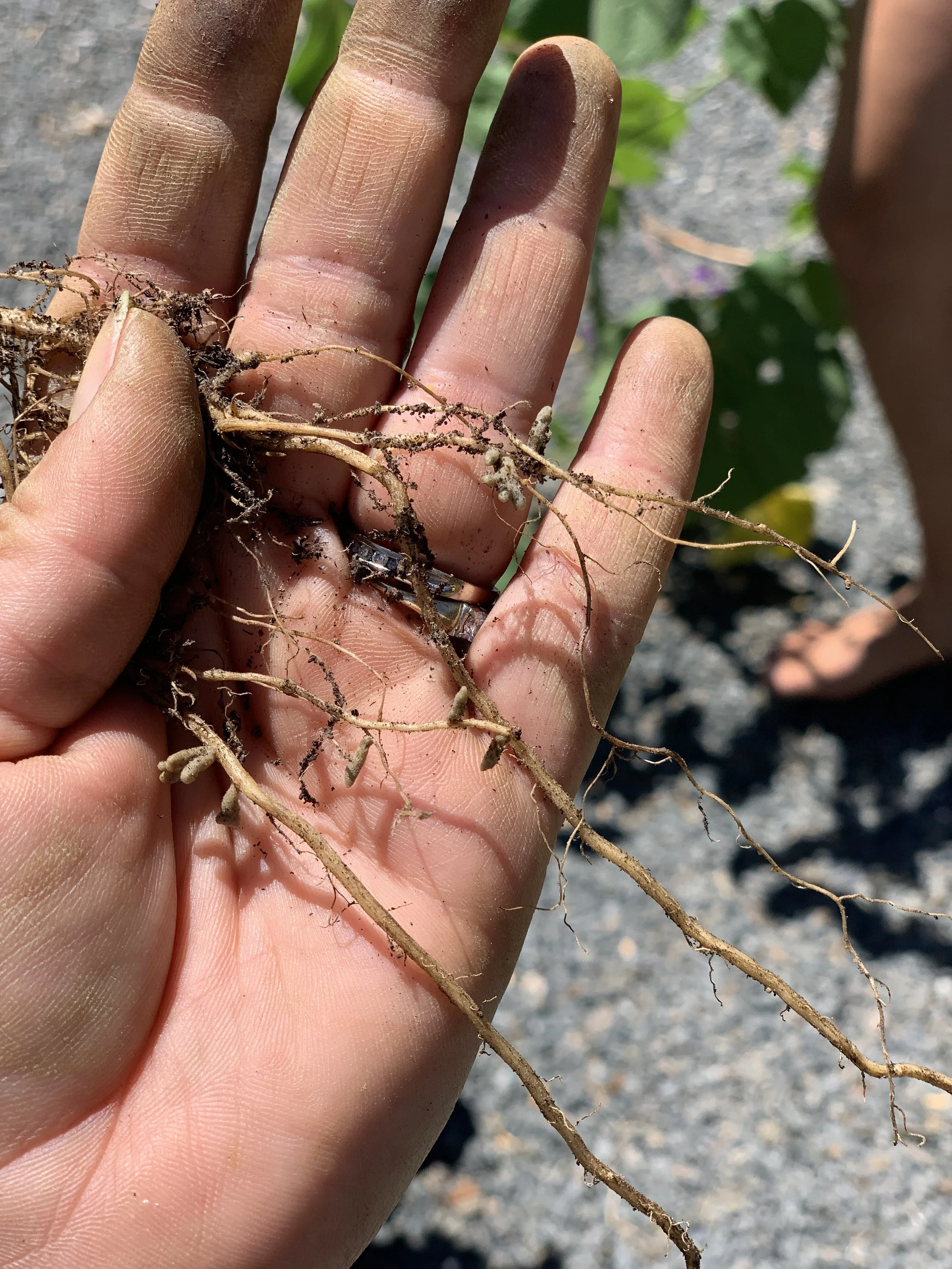
Nodules on Pea Roots
To witness this process yourself, pull out a pea or bean plant, shake off the soil, and look closely at the roots. You should see small, pale bumps along them. These are nitrogen-fixing nodules. If you don’t see them, it’s often a sign that something may be off in the soil. Compaction, disturbed soil biology, or excessive synthetic nitrogen can all prevent nodules from forming. When nitrogen is already abundant, the plant simply doesn’t maintain the partnership. If you’re interested in learning more, I highly recommend the Teaming series on organic growing by Jeff Lowenfels, who presents complex soil biology in an accessible and engaging way.
This year, I’m planning to experiment with clover as a living soil cover in half of my garden. At the end of the season, around our next equinox, I’ll compare the results. How did it affect soil health? Was it easier to manage than mulch? Was it more labor-intensive? And how did it influence the growth of nearby plants? I’ll share what I learn in a future article.
In the meantime, happy gardening!